• Skip to primary navigation
  • Skip to main content
  • Skip to footer
Live 2 B Healthy Senior Fitness

Live 2 B Healthy Senior Fitness

  • About Us
  • Our Fitness Programs
  • Healthy Aging Benefits
  • Franchise Opportunities
  • Locations
  • Contact
  • Careers
  • Press
  • Blog
  • Privacy Policy
  • Terms of Use
  • Cookies

Cory Czepa

Why Preventative Fitness is a Necessary Investment in Senior Wellness

October 9, 2026 by Cory Czepa

When most people think about senior fitness, they think about it reactively as something that becomes relevant after a health event, a fall, or a doctor’s recommendation. But the most powerful version of senior fitness isn’t reactive at all. It’s preventative! And the difference between those two approaches — in outcomes, in cost, and in quality of life — is enormous.

This is the philosophy at the heart of everything Live 2 B Healthy® does. Preventative fitness is not just another wellness amenity, but rather a strategy.

What Happens to the Body as We Age

The case for preventative fitness starts with understanding what aging does to the body when we don’t actively counter it.

Beginning in our 30s, adults lose 3–8% of muscle mass per decade — a process called sarcopenia. After age 60, that rate accelerates [1]. As muscle mass declines, so does balance, reaction time, and functional strength that allows someone to get up from a chair, step over a curb, or recover from a stumble without falling.

These changes are real, they are measurable, and for too long they have been treated as inevitable; However, The National Institute on Aging is clear: regular physical activity, particularly strength and balance training, can slow, halt, and in many cases partially reverse the physical effects of aging [2]. The body responds to exercise at every age. The question is whether we give it the opportunity.

The Stakes: Why This Matters More Than Most People Realize

Falls are the leading cause of injury for adults 65 and older in the United States. More than 1 in 4 older adults falls every year, resulting in over 3.85 million emergency department visits annually and more than 43,000 deaths [3, 4]. Over the past decade, fall-related deaths among older adults have increased by 51% [3].

But the cost of falls goes well beyond the physical injury. A fall can shatter a senior’s confidence so completely that they stop doing the things they love like going out, socializing, moving. That withdrawal from activity accelerates exactly the physical decline that caused the fall in the first place. It’s a cycle, and it can be very difficult to break.

For senior living communities, the financial reality is equally serious. According to the 2026 Cost of Senior Care report by SafelyYou, the average cost of a single fall incident is $10,900 in assisted living and $9,300 in memory care. When staff time, documentation, clinical follow-up, and resident transitions are factored in, falls cost the average community $380,000 per year [5].

These are not abstract figures. They represent real events, real people, and real consequences that a well-designed preventative fitness program is specifically built to address.

What Preventative Fitness Actually Means

Preventative fitness is not the same as general activity. Walking more, taking the stairs, staying busy — these are valuable, but they are not a substitute for targeted exercise that specifically addresses the physical factors most linked to fall risk and functional decline.

The National Council on Aging and the Centers for Disease Control both identify exercise-based programs (particularly those incorporating strength training, balance work, and flexibility) as the most effective evidence-based fall prevention interventions available [6, 7]. Research published in Life (2025), reviewing 27 randomized controlled trials, found that Tai Chi interventions were associated with 31–58% reductions in falls and multimodal strength-balance training with 20–45% reductions [8].

This is what preventative fitness means in practice:

– Strength training builds the muscle mass and response time that catches you when balance is disrupted

– Balance training develops the proprioceptive system that keeps you upright on uneven ground

– Flexibility work maintains range of motion so joints can move fully and the body can correct and recover

– Cardiovascular training supports the heart and circulatory system through the demands of daily living

When these components work together, consistently and over time, they change the physical trajectory of aging. Not just for individual seniors, but for the communities that care for them.
 

The Role of Fitness Assessments in Preventative Care

One of the most important and underused tools in senior wellness is measurement. Preventative fitness works best when it is tracked, documented, and tied to individual progress over time.

At Live 2 B Healthy®, we conduct biannual Fitcheck Assessments across all partner communities. These assessments measure the three factors most directly linked to fall risk and functional independence: balance, strength, and flexibility. Balance and lower body tests evaluate stability and leg strength, with progression tracked through measurable levels. Flexibility is assessed via a sit-and-reach test, tracking changes in mobility over time.

The goal is not to rank residents or create competition. It is to give each person and their care team a clear, documented picture of where they are, where they’ve improved, and where focused attention can make the biggest difference. Tangible progress builds motivation. Motivation drives participation. And consistent participation is what actually can move the needle on fall risk, independence, and quality of life.

For senior living communities, Fitcheck Assessment data also serves a practical purpose: it is evidence. It demonstrates, in measurable terms, that the wellness program is working — for residents, for families, and for leadership evaluating the value of their investment.

The Business Case for Senior Living Communities

For Executive Directors and Operations Leaders, preventative fitness is ultimately a financial conversation as much as a clinical one.

The math is straightforward: based on an average of 10 fall incidents per year at $10,900 per incident in assisted living, a community faces $109,000 in potential fall-related costs. A 47% reduction in falls — the average seen in some of our partner communities — represents $51,230 in potential cost reduction. Preventing just one fall per year covers the cost of the program entirely [5].

Beyond fall reduction, preventative fitness supports three other community performance metrics that matter to operations leaders:

Length of stay. Residents who maintain mobility and functional independence stay in their current care setting longer. Functional decline is one of the leading drivers of early transitions to higher levels of care and physical activity is one of the most proven ways to slow that decline.

Family confidence. Health-conscious families are increasingly evaluating senior living communities on the quality of their wellness programs. A structured, certified, measurable fitness program is a differentiator that influences move-in decisions and shapes the family experience throughout a resident’s tenure.

Staff efficiency. Fewer fall incidents means fewer reactive care events — less emergency documentation, fewer calls to clinical staff, less disruption to care routines. A healthier, more active resident population is also a more manageable one.

The return on investment for a well-run preventative fitness program is not difficult to calculate. The harder question is the cost of not having one.

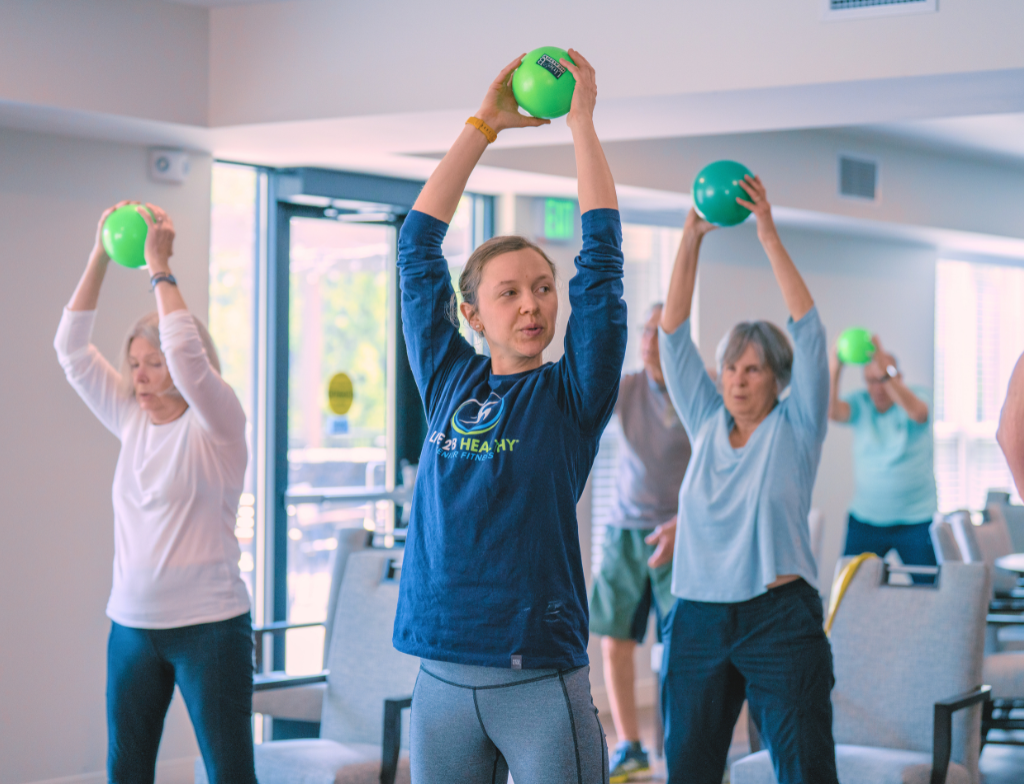
Live 2 B Healthy Senior Fitness Class

What Live 2 B Healthy® Does

Live 2 B Healthy® was built around preventative fitness from the beginning. Our certified fitness professionals bring on-site group classes, private training, and specialty programming — including strength and balance training, chair yoga, Tai Chi, aqua fitness and more — directly to senior living communities and individuals. Every program is adapted for every ability level.

Our Fitcheck Assessments track measurable improvement in balance, strength, and flexibility across every participant, providing the documented outcome data that tells the full story of what consistent preventative fitness does.

If you’re a senior living community interested in bringing a Live 2 B Healthy® senior wellness program to your residents, or an individual looking for exercise programs for seniors in your area, we’d love to connect.

Contact us today to learn more about our programs and find a location near you.
Sources & Citations

[1] Cruz-Jentoft AJ, et al. Sarcopenia: revised European consensus on definition and diagnosis. Age and Ageing. 2019. https://academic.oup.com/ageing/article/48/1/16/5126243 | [2] National Institute on Aging (NIA). Falls and Fractures in Older Adults: Causes and Prevention. https://www.nia.nih.gov/health/falls-and-falls-prevention/falls-and-fractures-older-adults-causes-and-prevention | [3] National Safety Council. Older Adult Falls — Injury Facts. (2026) https://injuryfacts.nsc.org/home-and-community/safety-topics/older-adult-falls/ | [4] Centers for Disease Control and Prevention (CDC). Facts About Falls. https://www.cdc.gov/falls/data-research/facts-stats/index.html | [5] SafelyYou. 2026 Cost of Senior Care Report. Commissioned by SafelyYou; conducted by Merrill Research across 175 senior living leaders. Released August 27, 2026. https://www.businesswire.com/news/home/20260827964389/en/SafelyYou-Releases-Landmark-Research-Revealing-the-True-Financial-Toll-of-Senior-Care-and-the-Path-Forward-for-Operators | [6] National Council on Aging. Get the Facts on Falls Prevention. https://www.ncoa.org/article/get-the-facts-on-falls-prevention/ | [7] Centers for Disease Control and Prevention (CDC). Older Adult Falls Data. https://www.cdc.gov/falls/data-research/index.html | [8] Choudhary PK, et al. Effectiveness of Balance- and Strength-Based Exercise Interventions for Fall Prevention in Community-Dwelling Older Adults: A Systematic Review of Randomized Controlled Trials. Life. 2025 Dec 26. https://www.ncbi.nlm.nih.gov/pmc/articles/PMC12842942/… See More

Fall Prevention: What Every Senior and Senior Living Community Should Know

September 11, 2026 by Cory Czepa

A fall changes everything. Not just physically, though a broken hip, a head injury, or a fractured wrist are serious enough on their own. A fall can shake a senior’s confidence so deeply that they stop doing things they love. That withdrawal from activity often starts a chain reaction that is far harder to reverse than the injury itself. 

The good news is that most falls are preventable. The risk factors are well understood, the interventions are proven, and the path forward is clear. This September, during National Fall Prevention Awareness Month, we’re sharing everything you need to know.

The Scale of the Problem

Falls are the leading cause of injury for adults 65 and older in the United States. More than 1 in 4 older adults — approximately 14 million people — falls each year [1]. In 2024 alone, 43,020 individuals aged 65 and older died as a result of preventable falls, and in 2023, over 3.85 million were treated in emergency departments due to fall-related injuries [2]. Over the past decade, fall-related deaths among older adults have increased by 51% [2].

The financial toll is equally staggering. The cost of treating injuries caused by falls among older adults is projected to exceed $101 billion annually by 2030 [1].

But the burden on senior living communities goes even further. According to the 2026 Cost of Senior Care report (landmark research commissioned by SafelyYou and conducted across 175 senior living leaders) per-incident fall costs in assisted living now average $10,900, and $9,300 in memory care. That’s nearly double the figures reported just four years ago. When the combined toll of staff time, documentation, clinical follow-up, and resident transitions is factored in, falls can cost a single senior living community an average of $380,000 per year [11].

For senior living communities, every fall carries consequences beyond the individual resident: liability exposure, family trust, staff resources, and community reputation. Falls are not a wellness amenity issue. They are an operational and financial imperative.

But perhaps the most important thing to understand is this: falls are not a normal or inevitable part of aging. They are a health risk, and like most health risks, they respond to intervention.

Why Falls Happen and What to Do About It

Understanding why falls happen is the first step to preventing them. The National Institute on Aging identifies the following as the most common contributing factors [3]:

– Muscle weakness, particularly in the legs and core.

– Poor balance and coordination.

– Medications that cause dizziness, drowsiness, or low blood pressure.

– Vision changes that make it harder to judge distances or see obstacles.

– Hearing changes affecting spatial awareness.

– Home hazards (loose rugs, poor lighting, lack of grab bars).

– Getting up too quickly, causing blood pressure to drop (postural hypotension).

– Chronic conditions including diabetes, heart disease, and nerve problems.

The reason this list gives us hope: every single item on it is addressable. None of these are fixed or unavoidable. They can be assessed, managed, and in many cases dramatically reduced with the right habits and the right support.

What the Research Says About Exercise

Of all the fall prevention strategies available, research consistently elevates one above the rest: regular physical activity. The National Council on Aging and the Centers for Disease Control both name exercise-based programs as the most effective evidence-based fall prevention intervention [1, 4].

Strength training builds the muscle response time that catches you when you slip. Balance training develops the proprioceptive system that keeps you upright on uneven ground. Flexibility work keeps joints moving through a full range of motion so the body can correct and recover. And cardiovascular training ensures the heart and circulatory system can support the demands of daily movement.

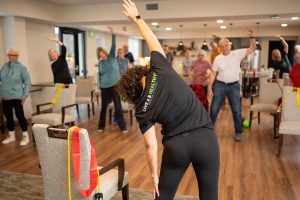
Live 2 B Healthy Senior Fitness

The National Institute on Aging puts it plainly: stay physically active, plan an exercise program right for you, and try balance and strength training exercises. Yoga, Pilates, and Tai Chi can all improve balance and muscle strength [3].

The NCOA also notes that evidence-based community falls prevention programs can significantly reduce falls and falls risk factors as well as reduce the costs associated with falls [6]. Over 275,000 older adults participated in NCOA-supported evidence-based falls prevention programs between 2014 and 2024 [7].

The Business Case for Senior Living Communities

For senior living operators, fall prevention is not a line item. It’s a bottom-line issue.

The 2026 SafelyYou research underscores what many operators already feel but struggle to quantify: the costs of falls compound in ways that aren’t always visible until they add up to a significant financial burden. At an average of $380,000 in annual fall-related costs per community [11], the return on investment for a proven prevention program is not difficult to calculate.

Beyond the direct costs, the SafelyYou report also found that 38% of assisted living leaders and 45% of memory care leaders report that care tasks frequently fall behind schedule — a signal of strained capacity that creates additional safety risk [11]. When teams are reactive rather than proactive, residents are at greater risk and communities absorb greater cost.

A specialized, on-site senior fitness program addresses this proactively. It builds the physical capacity residents need to stay steady, reduces fall frequency, decreases the clinical follow-up burden on staff, and signals to families that the community invests in resident safety. That trust influences move-in decisions, length of stay, and referrals.

What Live 2 B Healthy® Does Differently

Live 2 B Healthy® was built around exactly the kind of programming the research recommends. Our certified fitness trainers deliver on-site group fitness, private training, and specialty classes — including strength & balance training, Tai Chi, chair yoga, and more — directly to senior living communities and individual members.

What makes Live 2 B Healthy® different is specificity. Our trainers are certified and know how to adapt every movement for every ability level. Fitness assessments track measurable changes in strength, balance, and flexibility over time. And our programs are designed for consistency — the kind of regular, ongoing activity that the research shows actually moves the needle on fall risk.

Live 2 B Healthy Class

Communities that partner with Live 2 B Healthy® see meaningful, measurable reductions in fall rates. For more on our outcomes and approach, read our companion post: Fall Prevention in Senior Living — Why Live 2 B Healthy Is the Gold Standard.

Falls are preventable. The time to act is now.

If you’re a senior living community interested in bringing a Live 2 B Healthy® senior wellness program to your residents, or an individual looking for exercise programs for seniors in your area, we’d love to connect.

Contact us today to learn more about our programs and find a location near you.
Sources & Citations

[1] National Council on Aging. Get the Facts on Falls Prevention. https://www.ncoa.org/article/get-the-facts-on-falls-prevention/

[2] National Safety Council. Older Adult Falls — Injury Facts. (2026, March) https://injuryfacts.nsc.org/home-and-community/safety-topics/older-adult-falls/

[3] National Institute on Aging (NIA). Falls and Fractures in Older Adults: Causes and Prevention. https://www.nia.nih.gov/health/falls-and-falls-prevention/falls-and-fractures-older-adults-causes-and-prevention

[4] Centers for Disease Control and Prevention (CDC). Facts About Falls. https://www.cdc.gov/falls/data-research/facts-stats/index.html

[5] Choudhary PK, et al. Effectiveness of Balance- and Strength-Based Exercise Interventions for Fall Prevention in Community-Dwelling Older Adults: A Systematic Review of Randomized Controlled Trials. Life. 2025 Dec 26. https://www.ncbi.nlm.nih.gov/pmc/articles/PMC12842942/

[6] National Council on Aging. Helping Older Adults Find Falls Prevention Strategies to Stay Safe. https://www.ncoa.org/page/falls-prevention/

[7] National Council on Aging. Falls Prevention Programs Save Money and Improve Health Outcomes. (2026, August) https://www.ncoa.org/article/return-on-investment-of-evidence-based-falls-prevention-programs/

[8] Centers for Disease Control and Prevention (CDC). Older Adult Falls Data. https://www.cdc.gov/falls/data-research/index.html

[9] National Council on Aging. Evidence-Based Falls Prevention Programs for Older Adults. https://www.ncoa.org/article/evidence-based-falls-prevention-programs/

[10] National Council on Aging. National Falls Prevention Resource Center. https://www.ncoa.org/professionals/health/center-for-healthy-aging/national-falls-prevention-resource-center/

[11] SafelyYou. 2026 Cost of Senior Care Report. Commissioned by SafelyYou; conducted by Merrill Research across 175 senior living leaders. Released August 27, 2026. https://www.businesswire.com/news/home/20260827964389/en/SafelyYou-Releases-Landmark-Research-Revealing-the-True-Financial-Toll-of-Senior-Care-and-the-Path-Forward-for-Operators Full report download: https://go.safely-you.com/l/1034381/2026-08-25/4496n

Move More, Age Well: How Staying Active and Connected is Foundational for Successful Aging

August 10, 2026 by Cory Czepa

Aging well isn’t a matter of luck. It isn’t determined solely by genetics, either. For the millions of older adults living in senior communities across the country, successful aging is something built intentionally through daily choices, consistent habits, and the people we choose to surround ourselves with.

Two of the most powerful choices anyone can make? Moving your body and staying connected to others.

What Research Tells Us About Successful Aging

Inspired by neuroscientist and author Daniel J. Levitin in his book Successful Aging, we’ve identified four pillars that can predict how well people age: physical activity, quality sleep, proper nutrition, and stress reduction. Of these four, physical activity sits at the top, and for good reason.

When we reduce our activity as we age, we don’t just lose physical strength. We lose our sense of agency and control over our environment. That loss of confidence can trigger a downward spiral resulting in decreased motivation, reduced independence, and declining overall wellbeing.

The good news? The reverse is equally true. When older adults stay physically active, such as through senior fitness programs, that sense of agency comes back. Strength returns. Confidence builds. And the momentum compounds.

Senior wellness programs that incorporate strength training for older adults, balance training for fall prevention, and even chair yoga, Tai Chi, and aqua fitness for seniors don’t just improve physical health. They restore a sense of self-efficacy that is central to aging well.

Movement Does More Than You Think

Here’s what most people don’t realize: a single exercise class can touch nearly every pillar of healthy aging at once.

Physical activity is the obvious one. But consider what else happens during a well-designed senior fitness program:

  • Sleep can improve. During sleep, cerebrospinal fluid circulates through the brain and clears out toxins that accumulate during daily activity. Regular physical activity is one of the most evidence-backed ways to improve sleep quality, meaning exercise doesn’t just strengthen the body, it helps the brain detox itself overnight.
  • Stress can decrease. As we age, our bodies become more sensitive to prolonged stress, and the damaging effects build up faster. Movement is one of the most accessible and effective stress-reduction tools available.
  • Cognitive health protected. Research consistently links regular physical activity to reduced risk of cognitive decline. Exercise programs for seniors that incorporate coordination, balance, and rhythmic movement offer particular cognitive benefits by engaging the brain and body simultaneously. This is especially meaningful in memory care fitness programs, where tailored movement can support residents living with dementia or Alzheimer’s.

The Connection Most People Underestimate

Levitin’s research also points to something beyond the physical: the power of active social connection. Maintaining friendships, making new ones, and staying engaged with a community aren’t just good for the spirit. They’re protective for the brain!

This is where group-based senior fitness programs have an advantage that solo exercise simply can’t replicate.

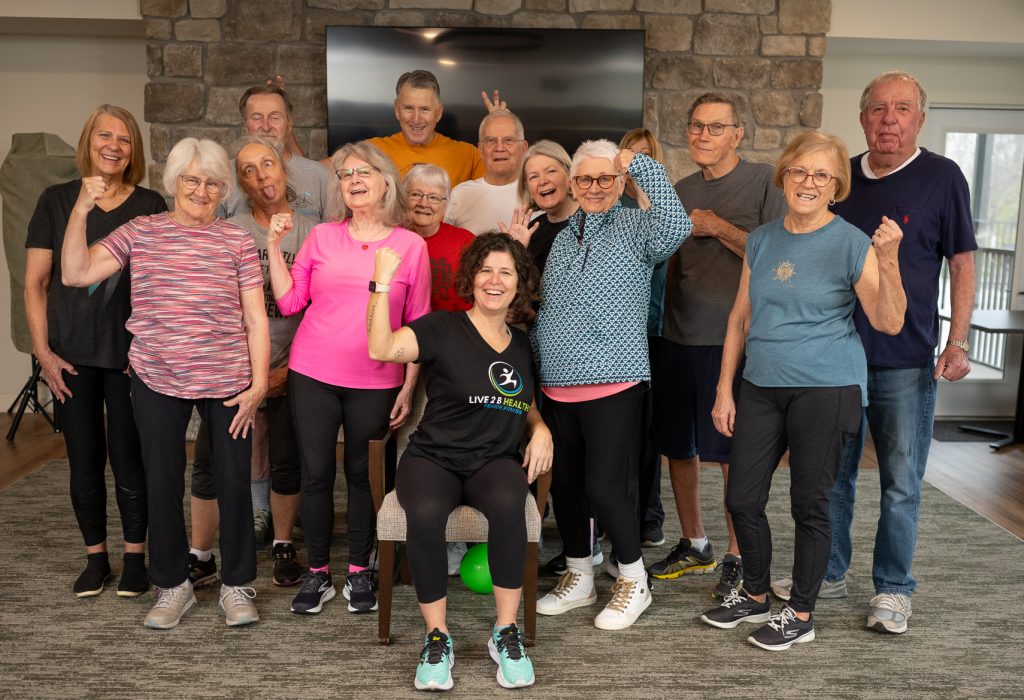
When an older adult shows up to a group class — whether it’s chair yoga for seniors, an aqua fitness program, or a strength and balance session — they aren’t just working out. They’re showing up to a community. They’re being greeted by name. They’re laughing with someone who was a stranger six months ago and is now a friend. They’re part of something.

That social fabric is one of the strongest things a senior wellness program can offer, and one of the most underrated.

“Move More, Age Well”

At Live 2 B Healthy®, our approach to senior personal training programs and group fitness is built on a simple but powerful belief: staying active and connected is foundational for successful aging.

Not just active in the gym sense. Active in the fullest sense: curious, engaged, moving through the world with confidence and purpose.

Our certified fitness professionals bring exercise programs for seniors directly into assisted living, independent living, memory care, and skilled nursing communities, meeting residents where they are. Programs are tailored to individual ability levels, whether that means a chair yoga class for residents recovering strength or a more dynamic strength training session for older adults who have been active.

The goal is not to turn seniors into athletes. The goal is to help every participant feel capable, connected, and in control of their health for as long as possible.

    Small Steps. Lasting Impact.

    Successful aging isn’t a destination you arrive at. It’s a practice built week by week, class by class, through the choice to keep showing up.

    The research is clear. The stories from our communities confirm it every day. Moving more and staying connected doesn’t just add years to life. It adds life to years.

    If you’re a senior living community interested in bringing a Live 2 B Healthy® senior wellness program to your residents, or an individual looking for exercise programs for seniors in your area, we’d love to connect.

    Contact us today to learn more about our programs and find a location near you.

    New Year, New Momentum: Move More in 2026 with Confidence and Care

    January 2, 2026 by Cory Czepa

    A new year is the perfect time for fresh starts, renewed routines, and simple goals that make a big difference. For older adults, one of the most impactful resolutions is also one of the most achievable: moving more—safely and consistently.

    Staying active supports independence, reduces the risk of falls, and improves overall quality of life. And the good news? Movement later in life doesn’t have to be intense or complicated to be effective. Small, intentional steps—done regularly—can lead to meaningful improvements in strength, balance, flexibility, and confidence.

    As we head into the new year, we’ve put together a practical guide to help seniors (and the communities that support them) make movement a sustainable part of everyday life..

    Why Mobility and Flexibility Matter More as We Age

    AAs our bodies change, so do our fitness needs. The focus shifts away from high-impact workouts and toward maintaining function, preventing injury, and supporting overall wellbeing.

    Improving mobility and flexibility helps older adults:

    summary here
    • Enhances balance and reduces risk of falls through improved muscle strength and better control.
    • Supports independence in daily activities like bathing, dressing, and walking.
    • Reduces joint stiffness, arthritis discomfort, and chronic pain.
    • Improves posture and coordination, helping with body awareness and comfort.
    • Boosts circulation, energy, cognitive function, and overall mood while supporting cardiovascular health.

    Remember, it’s never too late to start an exercise routine—even small steps over a consistent period of time can lead to powerful results.

    Simple, Senior-Friendly Exercises to Start the Year Strong

    Not sure where to begin? These approachable movement options can be done at home, in a group setting, or with guidance from a trained instructor. All can be modified to meet individual needs and abilities.

    Gentle Stretching

    Stretching increases flexibility and helps relieve sore muscles, body aches, tension, and other chronic conditions. It’s a type of regular exercise that every person should include in their daily lives, no matter their age.

    • Try neck rolls, shoulder shrugs, or overhead arm stretches.
    • Seated hamstring and calf stretches can loosen tight leg muscles.

    Exercise tip: move slowly, hold each stretch for 10–30 seconds, and avoid bouncing.

    For seniors, stretching is even more crucial, as it can give you the benefits of cardiovascular exercises (like improving heart rate and blood pressure) without the risk impact movement from activities like running.

    Balance and Core Strengthening

    Balance-improving activities help with coordination and reduce fall risk—key for bone health and disease prevention.

    • Heel-to-toe walks along a wall or nearby trail.
    • Standing leg lifts or side leg raises using a chair for support.
    • Seated abdominal twists to engage core muscles and support body position.

    Chair-Based Movement

    Perfect for individuals with limited mobility, chair-based exercises still provide meaningful benefits.

    • Chair yoga or seated stretching routines
    • Seated marches or leg extensions
    • Ideal for senior living communities and group classes

    Light, Low-Impact Cardio

    Cardiovascular movement supports heart health and overall endurance.

    • Short indoor or outdoor walks
    • Water-based exercise for joint comfort
    • Tai chi for balance, coordination, and mental well-being

    Even brief bouts of light cardio add up when done consistently

    Tips for Moving Safely and Comfortably

    Before starting or restarting an exercise routine, keep these best practices in mind:

    • Start small: 5–10 minutes a day is a great beginning
    • Use support: Chairs, resistance bands, or railings can improve safety
    • Stay hydrated: Bring water to every activity
    • Listen to your body: Check with healthcare providers when needed and pause if something doesn’t feel right
    • Make it enjoyable: Group classes, music, or variety keep routines engaging
    • Pair movement with nutrition: A balanced diet supports strength, energy, and recovery

    Making Movement Part of Everyday Life

    You don’t need a formal workout to stay active. Movement can be woven into daily routines:

    • Stretch while watching TV or after waking up
    • Take short walks around the house, hallway, or garden
    • Turn light chores into gentle activity
    • Move with others—family walks, simple games, or group classes
    • Use a weekly activity plan to stay consistent and motivated

    Move More, Live Better All Year Long

    The new year isn’t about perfection, it’s about progress. For older adults, regular movement is one of the most effective ways to support physical health, mental well-being, and independence at any age.

    If you’re looking for a supportive, structured way to get started, Live 2 B Healthy® partners with senior living communities nationwide to deliver fitness programs designed specifically for older adults. Our classes focus on balance, strength, flexibility, and social connection—led by certified trainers who understand the needs of aging adults.

    Whether your goal is to build healthy habits, improve mobility, or simply feel better moving through your day, Live 2 B Healthy is here to help your community start the year strong and stay active all year long.

    Contact us today to learn how your community can benefit from a Live 2 B Healthy fitness program.

    Move with Gratitude: How Senior Fitness Builds Strength, Joy, and Connection

    November 1, 2025 by Cory Czepa

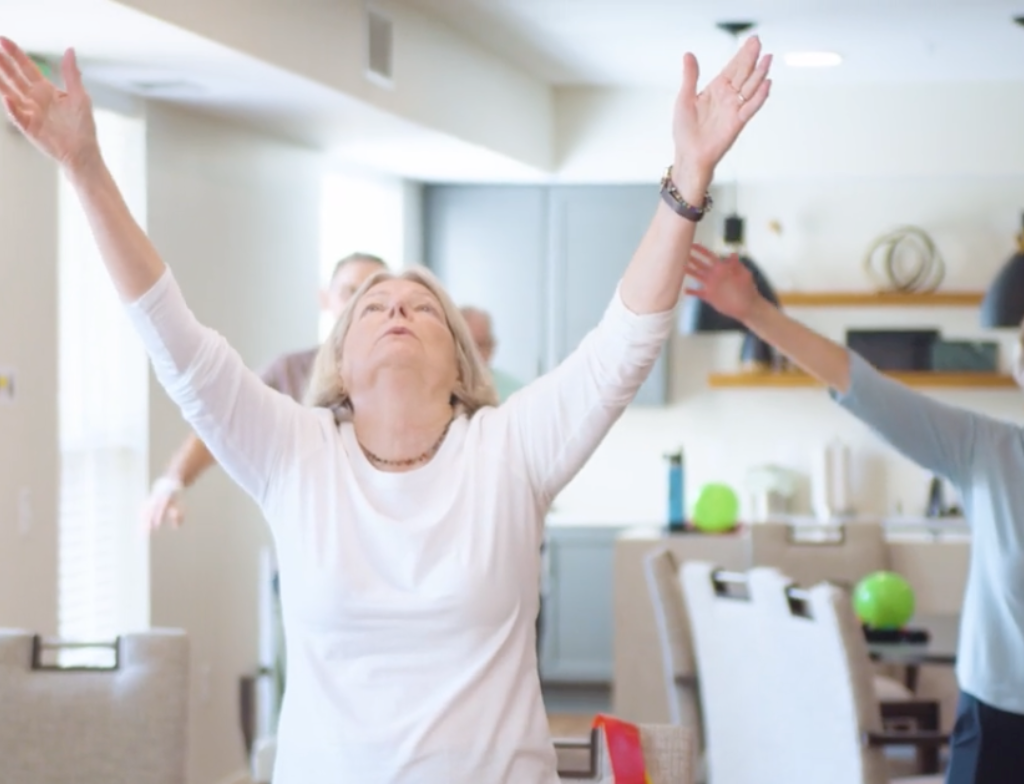
    Imagine walking into a bright community room where comforting music plays, chairs are neatly arranged and welcoming, and friendly voices fill the air. A few residents laugh as they test their balance, stretching arms wide with colorful resistance bands. A trainer smiles, offering encouragement: “You’ve got this – strong and steady!”

    Moments like these are more than just exercise—they’re gratitude in motion.

    At Live 2 B Healthy, fitness for older adults is about more than strength or flexibility. It’s about connection to the body, to one another, and to a deep sense of appreciation for what’s possible at every age. When we move with gratitude, we move toward wellness of the body, mind, and spirit.

    Why Movement Matters More with Age

    As we grow older, our bodies naturally change—but the power of movement never fades. Regular exercise remains one of the most effective ways to preserve independence, prevent injury, and improve quality of life.

    According to the Centers for Disease Control and Prevention (CDC), older adults who stay physically active can reduce their risk of falling by as much as 30%. Exercise can also strengthen the heart, sharpen the mind, and even lower the risk of depression and chronic disease.

    For many older adults, the benefits go beyond the physical. Movement restores confidence, boosts mood, and reminds us that age does not define ability.

    When seniors move regularly, they often experience:

    • Better balance and stability leading to fewer falls and greater confidence.
    • Increased strength and endurance making daily tasks like dressing, cooking, or shopping easier.
    • Improved flexibility and joint comfort, especially in safe, low-impact programs designed for arthritis or mobility limitations.
    • Enhanced mood and mental clarity – thanks to endorphins, laughter, and social connection.

    Movement isn’t about perfection. It’s about participation, it’s about showing up, even on the days when energy feels low, and discovering what the body can still do with care and consistency.

    The Gratitude Factor: Mindset Meets Movement

    Science shows that gratitude is one of the simplest yet most powerful ways to improve well-being. When practiced regularly, gratitude can lower stress hormones, improve heart health, and even strengthen the immune system.

    So what happens when you combine gratitude with movement?

    You get a powerful synergy, like a feedback loop of positivity that energizes both the mind and body.

    At Live 2 B Healthy, we see this every day. Participants often share small but meaningful reflections after class:

    • “I’m so thankful I can still move like this.”
    • “Every stretch reminds me how far I’ve come.”
    • “Thank you, your class gave me back my confidence.”

    These aren’t just feel-good moments, they’re the heartbeat of healthy aging. Gratitude shifts focus from what has been lost to what is still possible. It helps older adults celebrate progress instead of perfection, and encourages a sense of joy in every movement.

    What to Expect in a Senior Fitness Class

    If you’ve ever wondered what happens during a senior fitness session, you might be surprised by how accessible and fun it can be.

    Live 2 B Healthy offers programs that are personalized, inclusive, and research-based. Every session is designed to help older adults move safely and confidently, regardless of ability level.

    Here’s what a typical class includes:

    • Low-Impact, Functional Workouts
    • Each session focuses on safe, effective movements like:
    • Chair-based exercises for stability and accessibility.
    • Resistance band routines to strengthen muscles gently.
    • Balance and coordination drills to reduce fall risk.
    • Gentle cardio for heart health and endurance.

    Although every class is different, you’ll find that the movements mimic everyday activities such as standing up, reaching, lifting – which makes each class practical as well as powerful.

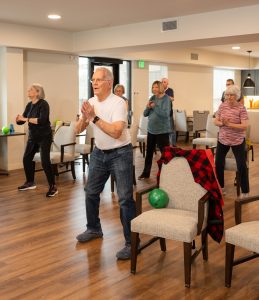
    Live 2 B Healthy Trainer in Group

    Our L2BH Supportive Trainers

    The Live 2 B healthy Certified trainers guide each participant with compassion, offering modifications and encouragement. They take time to explain why movements matter, helping participants build both physical strength and health literacy.

    Measurable Progress

    Bi-annually, simple fitness assessments provide a guide to track improvement over time. These tangible results motivate participants and reassure families that the program truly works.

    A Sense of Belonging

    Perhaps the most beautiful part of class is the camaraderie. Every smile, every shared laugh, every “you’ve got this!” builds community. It’s not uncommon to see participants stay after class to chat, connect, or express encouragement for one another.

    A Wellness Ripple Effect for Communities

    Across the country, senior living communities are discovering how fitness programs can transform daily life, not just for residents, but for staff and families too.

    When a wellness culture takes root, the impact reaches far beyond the exercise room:

    1. Residents grow stronger and more independent.
    2. Falls and hospital visits decrease.
    3. Staff see happier, more engaged residents.
    4. Families notice improved mood and mobility in their loved ones. 

    Communities that partner with Live 2 B Healthy often share that classes have become the highlight of the week because of their action to bringing people together in joy, movement, and gratitude. 

    As one community director put it: 

    “You can feel the difference in the energy of the building. Residents look forward to class, staff get involved, and families see their loved ones smiling again.”

    This sense of shared vitality builds not just strength, but connection.

    Real Voices of Gratitude

    The heart of the program lives in the people it serves. Here are just a few reflections from participants across Live 2 B Healthy communities:

    “I used to feel nervous going down the hallway with my scooter. Now I feel confident because I no longer need it”
    “I’m grateful for the friends I’ve made here, we laugh, we move, we truly just have fun.”
    “This program gave me my independence back.”

    Each story is a reminder that fitness is about more than reps or routines, it’s about reclaiming a sense of purpose and pride in one’s own body.

    How to Get Started

    Whether you’re an older adult looking for classes or a senior living community hoping to inspire residents, it’s never too late to move with gratitude.

    For Individuals

    • Search senior fitness classes near me or look up one of our locations by clicking here.
    • Look for certified trainers and programs that emphasize safety, fun, and community.
    • Invite a friend or family member to join you to exercise, it can be better together! If you’re not ready for group fitness classes, ask us about our private training.

    For Senior Communities

    • Explore wellness partnerships with Live 2 B Healthy, offering customized programs for independent living, assisted living, memory care settings and more.
    • Ask your local Live 2 B Healthy contact if they offer any demo classes to experience the benefits firsthand.
    • Foster a community culture where wellness and gratitude go hand-in-hand.

    Final Thoughts: A Grateful Path to Lifelong Wellness

    Aging is not about slowing down, it’s about showing up, – one movement at a time. When older adults exercise with gratitude, every stretch becomes a celebration, every class a chance to connect, and every step a reminder of resilience. 

    At Live 2 B Healthy, we’re thankful for every participant, every trainer, and every community that chooses to make movement a priority. Together, we’re redefining what it means to age well – with strength, laughter, and a grateful heart. Because when we move with gratitude, we don’t just grow stronger, we grow together. 

    Health Literacy Month: A Vital Opportunity for Aging Well and Staying Empowered

    October 3, 2025 by Cory Czepa

    Every October, Health Literacy Month shines a spotlight on one of the most important yet overlooked aspects of health: the ability to understand and act on health information. For aging adults, this skill isn’t just a convenience—it’s a lifeline.

    Strong health literacy helps older adults manage medications, make informed decisions about care, prevent avoidable hospital visits, and maintain their independence. Without it, daily life becomes more complicated, risks rise, and loved ones shoulder a heavier burden.

    At Live 2 B Healthy®, we believe that wellness starts with understanding—and that movement can be one of the most powerful tools for learning and connection. This blog explores why health literacy is so vital for aging adults, how families and caregivers can help, and how programs like Live 2 B Healthy make a difference.

    The Current Landscape: What the Numbers Say 

    The Centers for Disease Control and Prevention (CDC) has found that many older adults face challenges when it comes to health information. (CDC Health Literacy) 

    • -71% of adults over age 60 have difficulty using printed health materials like brochures or pill bottle instructions.

    • -80% struggle with forms or charts (insurance forms, medical history, nutrition guides).

    • -68% find interpreting numbers and calculations difficult (dosages, blood pressure readings, lab results).

    These challenges aren’t minor—they can lead to skipped medications, misunderstood instructions, unnecessary hospital visits, and a reduced quality of life. With the senior population expected to reach 71.5 million by 2030, the need for clear, accessible health communication will only grow.

    The Benefits of Strong Health Literacy for Aging Adults

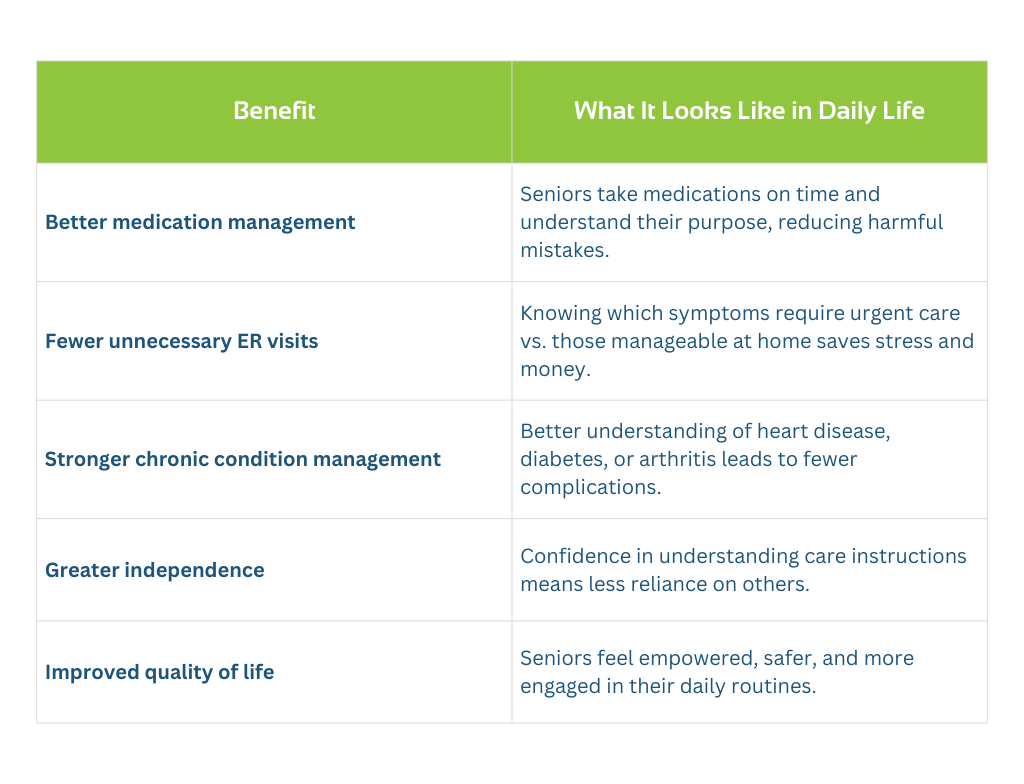
    Improving health literacy offers real-world benefits for seniors and their families:

    Research shows that low health literacy is linked to higher healthcare costs, poorer health outcomes, and less use of preventive care like screenings and vaccinations. On the other hand, clear, supportive communication can change lives.

    Barriers Aging Adults Face

    Why do so many older adults struggle with health information? The reasons vary, but common challenges include:

      • -Vision, hearing, or cognitive changes that make it harder to read, hear, or remember instructions.

      • -Complex health systems with small print, technical jargon, or confusing paperwork.

      • -Confidence gaps, where seniors hesitate to ask questions or admit they don’t understand.

      • -Misinformation online, where it’s difficult to separate fact from fiction.

    Understanding these barriers helps families, communities, and organizations like Live 2 B Healthy® design solutions that work.

    What Loved Ones and Caregivers Can Do

    Families and caregivers play a vital role in bridging the gap. Here are practical steps anyone can take:

      1. Use plain language and visuals. Replace medical jargon with everyday words, use larger fonts, and add visual aids like icons or color coding.

      1. Encourage questions. Remind loved ones it’s okay to say, “I don’t understand.” Create a safe, open dialogue.

      1. Practice “teach-back.” After explaining something, ask the older adult to repeat it in their own words. This confirms understanding.

      1. Offer multiple formats. Some seniors learn best by hearing, others by seeing. Combine written instructions with demonstrations or videos.

      1. Simplify the environment. Use good lighting, large-print forms, and remove background distractions when reviewing information.

      1. Prepare for appointments. Write down questions ahead of time and bring a trusted support person along.

      1. Stay alert to misinformation. Help evaluate whether information comes from a credible, evidence-based source.

    These small steps add up, giving seniors the tools and confidence to manage their health more effectively.

    Movement as a Path to Understanding

    Health literacy isn’t just about reading materials—it’s also about making sense of the body, health routines, and preventive strategies. That’s where Live 2 B Healthy® steps in.

    In every class, certified trainers explain not only how to do the exercises, but why they matter. Seniors learn that strengthening leg muscles improves balance, stretching helps prevent falls, and movement supports heart and brain health.

    Because classes are interactive, seniors have the opportunity to ask questions in real time, see demonstrations, and practice safely in a supportive group setting. This combination of physical activity and simple, practical education makes health concepts easier to grasp—and remember.

    In fact, many participants share that they “can really see the benefits” as their balance improves and daily tasks feel easier. These aren’t abstract lessons; they’re lived experiences.

    Health Literacy Matters at Live 2 B Healthy

    Building a Culture of Wellness in Communities

    For senior living communities and assisted living directors, Health Literacy Month is an opportunity to create an environment where education and wellness go hand in hand.

    Perhaps consider hosting a “Fitness & Facts” workshop, where a Live 2 B Healthy class is paired with a short health-literacy discussion, which can spark meaningful engagement. Residents walk away not only with stronger muscles, but also with clearer knowledge about why health routines matter.

    Why Health Literacy Month Matters Right Now

    October’s Health Literacy Month is the perfect reminder that seniors deserve health information they can understand and use. But the work doesn’t stop at the end of the month. Every day offers opportunities to make wellness more accessible.

    By weaving clear communication into fitness programs, newsletters, family conversations, and community events, we can ensure that seniors are not left behind in an increasingly complex healthcare system.

    Key Takeaways:

      • -71% of adults over 60 struggle with print health materials.

      • -80% struggle with forms or charts, and 68% struggle with numbers.

      • -Low health literacy leads to higher costs, more hospital visits, and lower quality of life.

      • -Families can help by simplifying communication, encouraging questions, and confirming understanding.

      • -Live 2 B Healthy provides a natural bridge between movement and understanding, reinforcing key health concepts through fitness.

    Fitness is fun

    Closing Thought

    Health Literacy Month isn’t only about forms and paperwork, it’s about giving older adults the confidence and clarity to live well. When seniors understand their health, they can take meaningful steps toward independence, safety, and joy.

    With the right support from loved ones, communities, and partners like Live 2 B Healthy®, every older adult has the chance to thrive—not just in October, but all year long.

    Ready to increase fitness through wellness and literacy in your community? Contact Live 2 B Healthy today and discover why we are the gold standard in Senior Fitness. 

    • Page 1
    • Page 2
    • Page 3
    • Interim pages omitted …
    • Page 6
    • Go to Next Page »

    Proud to be partnered with

    Footer

    • Facebook
    • Instagram
    • LinkedIn
    • YouTube

    Select photos on this site were taken live at Zvago Stillwater Cooperative, a senior housing cooperative and valued community partner for over 2 years.

    Website
    • About Us
    • Blog
    • Careers
    • Press
    • Corporate Contact
    • Home
    Participants
    • Locations
    Franchise
    • Own a Franchise

    © Live2BHealthy © 2023–2026. All rights reserved

    • Privacy Policy
    • Terms of Use

    Get In Touch

    Use this form for all general inquires. We look forward to connecting with YOU!

    "*" indicates required fields

    This field is for validation purposes and should be left unchanged.
    Texting Consent*
    https://live2bhealthy.com/privacy-policy/
    Address*